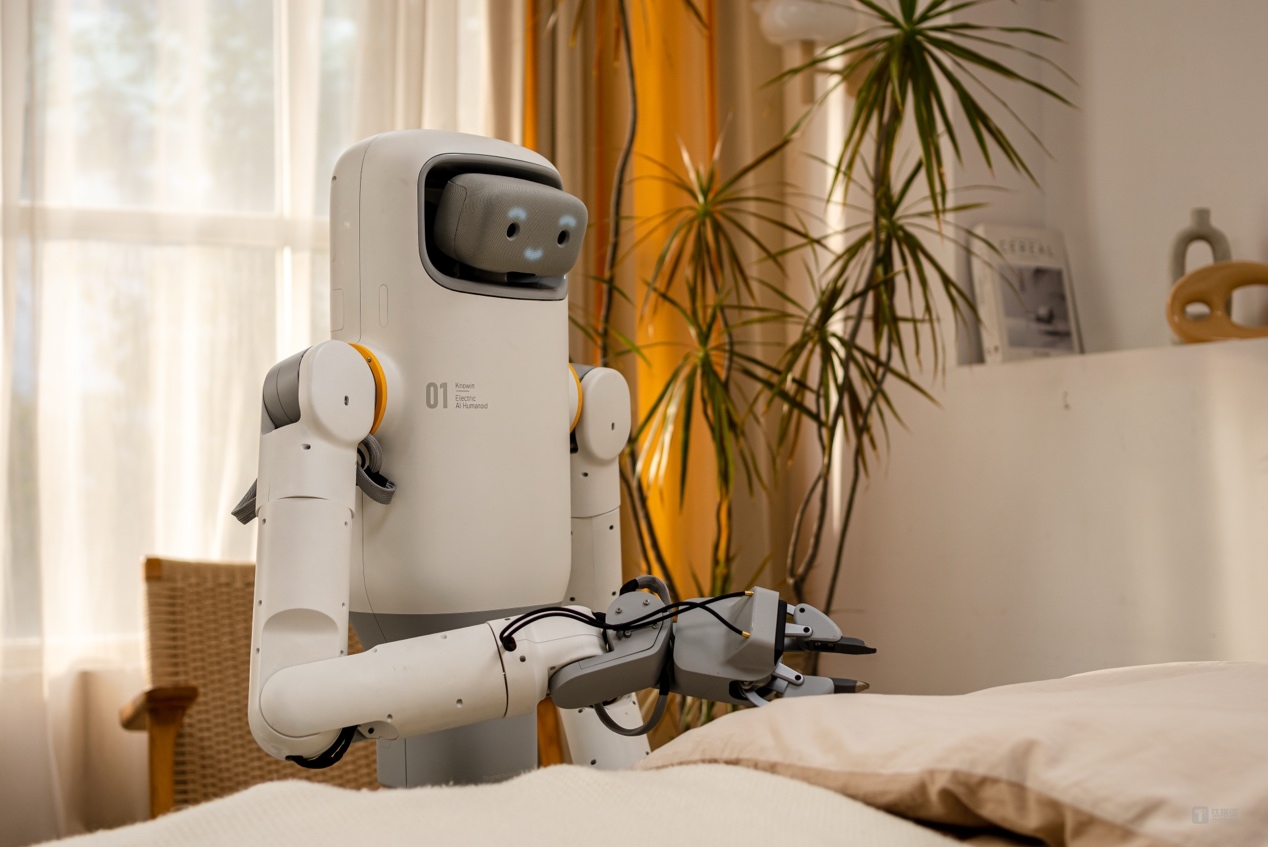


KNOWIN, a developer of household humanoid robots, has announced the completion of an Angel+ funding round, valuing the company at over RMB 2 billion post-money.
The round was led by CDH Capital, with continued participation from existing shareholders including L2F Photon Entrepreneurs Fund and Source Code Capital’s “Rhythm” unit, while Photon Capital served as the exclusive financial advisor. The proceeds will be primarily used to ramp up the global recruitment and development of top-tier talent, deepen R&D across the company’s full-stack technology system, and accelerate iteration, refinement, and mass-production of its core products—advancing consumer-grade home embodied-intelligence products from key technological breakthroughs to scaled commercialization.
In recent years, as population aging has accelerated and the share of dual-income urban households has remained high, the supply of labor within households has become increasingly tight, and the hidden costs of domestic work have continued to rise—making demand for efficient, automated home-service solutions ever more urgent. At the same time, breakthrough progress in large AI models and computing power has reshaped robots’ cognitive and execution logic, creating a new technological paradigm for home services. The release of rigid market demand and the empowerment from rapid iteration in frontier technologies are reinforcing each other, pushing large-scale deployment of home embodied intelligence from vision to reality.
Compared with industrial settings, home environments are far more unstructured, with a more pronounced long tail; task types are highly diverse and change frequently. Consumer-facing home robots therefore need to reach a much higher bar in multi-task generalization, autonomous decision-making, and safe interaction—while also keeping costs and pricing within a range consumers can accept. What users truly want is not merely “semi-automated assistance,” but the ability to autonomously complete high-frequency household chores in a closed loop—for example, end-to-end execution of typical workflows such as floor cleaning, post-meal tidying, and bathroom cleaning. To move in this direction, home robots must achieve a closed-loop “perception–decision–execution–feedback” workflow within the clearly bounded home space, and be capable of autonomous standby, task switching, and handling anomalies and/or handing control over when needed.
Noyin was founded in July 2025, primarily targeting consumer household scenarios. Focusing on modern families’ diverse needs—such as companionship and interaction, entertainment, and high-frequency collaboration on household chores—it is building an embodied intelligence system with a physical form that can operate in real environments and form a closed loop of “perception — generation — execution — evolution,” enabling continuous interaction.
Notably, over the past six months Noyin completed three consecutive funding rounds, raising a cumulative total of several hundred million RMB, and has already become a leading company in the home embodied-intelligence space.
Noyin founder Li Yinchuan previously served as the head of the AIGA (AI Generated Action/Agent) initiative at the research institute of a leading domestic tech company. He has long focused on foundational research and engineering deployment in areas such as generative decision-making, and has built solid expertise and hands-on experience across embodied intelligence, large models, and autonomous driving (by age 30, he had published about 80 high-caliber papers, including collaborative work; and as first inventor, he held or filed more than 30 patents, including both granted and pending). He has consistently upheld a philosophy that values both “innovation + implementation.” Even as a student, he emphasized engineering capability and hands-on practice, and once won first place with a perfect score among 800+ teams in the “Beijing Electronic Design Contest.”
On the team side, Noyin has brought together core members with both academic depth and industry experience, mainly from large tech companies’ large-model algorithm teams and from seasoned engineering and product teams in consumer electronics. The team has end-to-end in-house R&D and vertical integration capabilities—from models to systems, from software–hardware co-design to productized delivery. Overall, the team skews young, with an average age close to that of the post-2000 generation, and demonstrates exceptional rapid learning and highly efficient collaboration. As of February 2026, the company’s team had grown to nearly 100 people, with more than two-thirds holding PhDs or higher degrees, and 20+ members having served as technical leads at major tech companies (including technical directors and above), forming a dual-engine talent structure of “young, elite talent + hard-core specialization” and “academic frontier + industry battle-tested execution.”
Given the complexity of home scenarios and their long-tail distribution, today’s mainstream technical approaches are still evolving. On the data side, training data often relies on lab demonstrations, limited real-world trajectories, and publicly available videos, leaving significant room to improve generalization to unknown environments and novel task combinations. On the objective and representation side, traditional VLA systems are typically optimized around aligning vision–language–action and reproducing behaviors; deeper modeling of the semantic structure behind actions and a composable skill space is still needed. As a result, models behave more like they are “matching/reusing” existing action fragments rather than generating feasible new strategies based on goals and constraints, making it difficult to handle the highly long-tailed and constantly changing task demands found in real homes.
To address this challenge, Nuoyin proposes a technical path from VLA to AIGA: shifting from “imitating what exists” to “generating what is needed.” By modeling a more complete action space and skill structure, and combining that with large-scale synthetic-data training, robots can, under the constraints of real-time environmental state and long-horizon task objectives, autonomously generate action sequences and execution strategies better suited to the current context. With less reliance on real demonstration data, they can gradually develop transferable, composable new skills—significantly improving adaptability and practicality in home settings.
Building on a deep understanding of the endgame for embodied intelligence, Nuoyin focuses on the core challenges of home scenarios—“long-tail environments + cost constraints + a delivery closed loop”—and builds long-term moats along three main threads: engineering, technology, and the data stack, forming differentiated competitive advantages.
First is full-stack in-house development and engineering-driven cost reduction. Through coordinated hardware–software design and continuous engineering optimization, the company drives cost down at scale while maintaining performance and reliability, removing key pricing barriers to the mass adoption of consumer products.
Second is a generalizable embodied foundation model for home scenarios. In response to the multi-step, highly compositional, and strongly long-tailed nature of home tasks, Nuoyin moves beyond traditional imitation-learning frameworks. With innovative model architectures and training methods, it emphasizes modeling task structure, skill composition, and the execution feedback loop—enabling deep understanding and strongly generalizable execution for complex, multi-step household tasks. This allows robots to maintain more stable perception, planning, and execution capabilities in diverse and dynamically changing home environments, while also ensuring safe interaction and controllability.
Finally, there is the synthetic-data-driven, product closed-loop flywheel. Noin centers its approach on proprietary synthetic data, building a training system tailored to embodied manipulation: through scalable task generation, action/trajectory generation, and filtering mechanisms, it continuously produces high-quality training data that covers long-tail scenarios, which is then used to train embodied foundation models with stronger generalization. Compared with routes that rely heavily on demonstrations and real-world data collection, the company places greater emphasis on a “controllable, scalable, and iterative” synthetic-data pipeline, and feeds back product and real-hardware runtime signals—such as feedback, failure cases, and abstractions of critical scenarios—into its data generation and evaluation system, forming a closed-loop flywheel of “product feedback → synthetic enhancement → training iteration → experience improvement.” Backed by a high-quality synthetic-data pipeline, it continues to drive model capability gains, creating a hard-to-replicate self-evolving system and cementing long-term technical barriers. This route has a high engineering threshold; Noin has already validated the key links and established a sustainable gain-and-verification system for embodied manipulation and task generalization.

Noin’s core model capabilities have reportedly been benchmarked across multiple open-source evaluation suites, achieving a clear lead on key metrics for household-related tasks; the company’s first full-size home robot prototype has also completed functional validation across multiple high-frequency household task chains, covering critical steps in typical workflows such as cleaning, tidying, and organizing, while product iteration and mass-production preparations are progressing in an orderly manner.
Looking ahead, the company will continue to deepen its focus on home scenarios, working to bring intelligent robots with “end-to-end takeover” capabilities into everyday household life—advancing embodied intelligence from “frontier technology exploration” to a “must-have household staple,” and ushering in a new paradigm of human–robot coexistence and autonomous intelligent living at home.
Zheng Xuanle, Founder and CEO of Light Source Capital and Founding Partner of the L2F Light Source Founder Fund, said: “The L2F Light Source Founder Fund has been truly honored to make a decisive investment in Nuoyin from Day 1, and to keep doubling down with conviction through the three consecutive rounds it completed in less than half a year. We strongly identify with—and are highly optimistic about—founder Li Yinchuan’s deep, cutting-edge foundation in embodied intelligence and AIGA, as well as the world-class engineering execution and full-stack vertical integration demonstrated by core members from leading global tech-hardware companies.”
Huang Yungang, Managing Partner at Source Code Rhythm, said: “We remain optimistic about the long-term value of the robotics track. As model capabilities continue to evolve, more and more application scenarios will be unlocked, and the home is one of the most imagination-rich frontiers.”
更多精彩内容,关注钛媒体微信号 (ID:taimeiti),或者下载钛媒体 App