(本文作者为 Chelsea_Sun,钛媒体经授权发布)

NextFin News -- This year, it feels like hardly anyone in China is paying attention to the World Cup.
The coolness among Chinese fans isn’t just because the national team isn’t there. CCTV’s negotiations with FIFA over broadcasting rights have gotten stuck in a tug-of-war over pricing, and even on the eve of kickoff, nothing has been finalized. A 12-to-15-hour time difference means more than half the matches will air in China in the early hours of the morning. CSL attendance is up by 30%, while “Village Super League” football and short videos have siphoned off what limited attention there is. On e-commerce platform homepages, the space that used to go to World Cup merchandise has been shoved into a corner by the 618 mid-year promotion.
In China, the World Cup has shrunk from a nationwide ritual to something that’s almost fizzled out.
The global market is a different story. FIFA projects this World Cup will reach roughly 6 billion people, and the 16 stadiums are expected to host more than 5 million spectators in person. Across the Americas, Europe, Africa, and Southeast Asia, it remains the single biggest attention event on the planet, with both brand sponsorship prices and bidding for national broadcasting rights hitting record highs.
Messi has confirmed he will retire after this tournament. Ronaldo hasn’t set a date, but this will very likely be his last World Cup as well. A “twilight of the gods,” this summer.
Against this backdrop—“China cooling off, the world on fire”—one phenomenon is worth noting: Chinese fans are paying less attention, but Chinese companies haven’t been absent. Not only have they not stayed away; they’ve embedded themselves into the event’s operational nervous system.
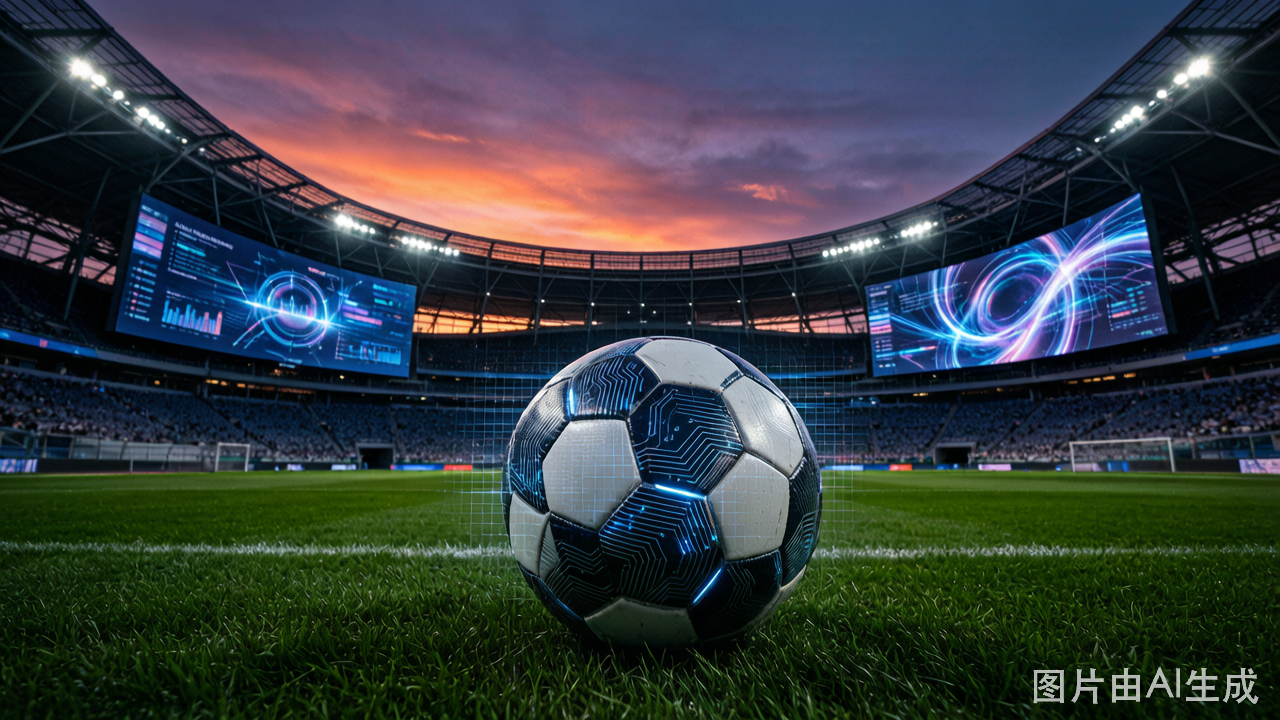
The sensor chip inside the ball at Mexican fans’ feet is made in Shenzhen. The Hisense screens the referees watch determine whether a goal counts. The computing power supplied by Lenovo keeps the VAR system running.
Every minute of the World Cup is speaking on behalf of these Chinese products. Even as China is absent in sporting terms, it has found a different kind of presence at the level of technology and supply chains—if the team didn’t go, the factories did.
But there’s no need to romanticize this “presence” too quickly. First, it’s worth looking at how deeply Chinese companies are involved, and how exactly that involvement is happening.
What You Can See—and What You Can’t
Let’s start with hardware. The LED display system at Estadio Azteca in Mexico City has a total in-venue area of more than 2,200 square meters, including the main giant screens on the north and south ends, the inner-bowl ribbon displays, exterior large screens, and massive pillar screens. The supplier is Leyard. The company once built the “scroll painting” installation for the opening ceremony of the Beijing Olympics, and it is a leading player in the global LED display industry.
At BC Place Stadium in Vancouver, Canada, the 600+ square-meter central LED funnel screen hanging over the middle of the venue was supplied by Absen—the largest suspended in-venue display system of its kind in Canada. Absen’s business now spans more than 140 countries and regions worldwide.
Unilumin, meanwhile, provided lighting-and-display solutions for match venues and fan-activity zones across the U.S., Canada, and Mexico, with nearly 1,000 square meters of LED display screens, and built a giant LED “ball screen” at the Dallas Fan Festival in the United States. Unilumin had already appeared at the 2022 Qatar World Cup.
Beyond the screens, NovaStar supplied the video display-control solution. Put simply, the LED screens are the “monitors,” while NovaStar provides the “control system.” According to incomplete statistics from LEDinside, at least eight Chinese display-related companies took part in this World Cup, covering everything from stadium big screens and control systems to packaging components, referee display terminals, and AI viewing devices.
On the pitch, the official match ball, “Trionda,” had a built-in 500 Hz motion-sensing chip that could help referees make offside calls, and the smart chip module was manufactured by a Chinese factory. From stadium big screens to match balls, China-made products accounted for a sizable share of the hardware infrastructure.
The hardware was laid into the stadiums, while another track ran straight from Chinese factories to fans’ doorsteps.
Forty-eight teams, 104 matches—upsets kept coming, and emotions swung sharply. Under the traditional model, overseas supermarkets placed container orders six months in advance; by the time the goods arrived at port, that dark-horse team might already have been knocked out. Now, China’s cross-border e-commerce network has drastically shortened the cycle: after seeing a goal clip on a short-video platform, a fan places an order; leveraging a flexible supply chain, Chinese factories complete sampling, ramp up production, and ship within a matter of days; the goods then fly directly to North America via dedicated cross-border lines and arrive in about a week.
This system has compressed the traditional 60–90-day supply chain to less than a week. What enables that speed is the collaborative network behind cross-border e-commerce: short-video platforms amplify consumer sentiment, flexible supply chains deliver rapid production, e-commerce platforms reach users, and logistics networks such as Cainiao handle cross-border delivery.
According to Sensor Tower, Temu was downloaded about 550 million times in 2024, up 69% year over year, ranking No. 1 among shopping apps in more than 40 countries. Cainiao launched dedicated lines for lightweight parcels and a California line at its U.S.-Canada-Mexico nodes, opening up cross-border delivery from the United States to Mexico.
Beyond hardware and logistics, a looser Chinese presence also showed up around the World Cup. Labubu, an IP under Pop Mart, entered an officially licensed co-branded partnership with FIFA in March 2026, becoming the first officially licensed designer-toy IP in FIFA’s history. At the opening match, Labubu appeared at Mexico City’s Estadio Azteca as a “special guest of the tournament” and also featured in the MV for the World Cup’s official single.
Behind the Calls
This World Cup was widely seen by multiple industry observers as one in which AI was applied at a relatively deep level.
For offside decisions, the system combined data from dozens of in-stadium tracking cameras to determine in real time whether a player’s body had crossed the line. As FIFA’s “Official Technology Partner,” Lenovo deployed engineering teams to all 16 stadiums, rolling out tens of thousands of devices to provide computing power for the relevant systems. That said, Lenovo mainly provided compute capacity and hardware deployment, while the core offside-decision algorithms were still led by overseas technology providers. This World Cup already saw cases in which AI-assisted refereeing led VAR to overturn on-field decisions.
The dedicated display equipment used in the Video Referee Center was provided by Hisense. As the “Official VAR Display Technology Partner,” the referee team used Hisense RGB-Mini LED TVs when reviewing slow-motion replays and drawing lines for decisions. This meant Hisense products became part of the technology chain behind World Cup officiating.
On match broadcasts, Tencent Cloud provided technical support to official rights-holding broadcasters across 16 countries and regions worldwide, covering markets including China, South Korea, Thailand, Brazil, Mexico, and Argentina. Tencent said that more than 70% of online football fans in China watched matches through its technology. Alibaba Cloud, meanwhile, provided underlying support for streaming distribution for multiple broadcasters via its global CDN nodes. Lenovo, Hisense, Tencent Cloud, and Alibaba Cloud each entered three links—refereeing technology, officiating displays, and broadcast distribution—forming a technology chain that ran from on-pitch decisions to off-pitch viewing.
What needs to be clarified is that Chinese companies do not play the same role across these links. Take offside decisions as an example: the core algorithms of the Semi-Automated Offside Technology (SAOT) system are led by the UK’s Hawk-Eye (owned by Sony); Germany’s Kinexon provides sensor support; and the 500 Hz motion-sensing chip inside the ball was designed by Adidas and manufactured in Chinese factories. Lenovo provides computing power and on-site hardware deployment, while Hisense supplies the dedicated screens used for referees’ replay reviews. Both are critical components, but the core algorithms are still mainly dominated by overseas companies.
This shift in technological depth is also reflected in changes to sponsorship strategy.
At the previous Qatar World Cup, total sponsorship by Chinese companies was about US$1.395 billion, according to Global Data—more than 30% of global sponsorship—while brands such as Hisense, Wanda, vivo, and Mengniu appeared densely along the pitch-side advertising boards. At this World Cup, the number of Chinese companies among official sponsors has declined. Lenovo, Hisense, and Mengniu together contributed about US$350 million; with Wanda included, the four companies’ combined spending exceeded US$500 million. Wanda was downgraded from a “Global Partner” to a “China Regional Partner” due to issues in contract performance.
This isn’t simply a “pullback.” On the one hand, the pace of negotiations over CCTV’s domestic broadcasting rights affected some companies’ willingness to sponsor. On the other hand, the more noteworthy change is that Chinese brands are shifting from “exposure-driven sponsorship” to “technology-embedded participation.”
Lenovo is not an ordinary sponsor—it is FIFA’s top-tier Official Technology Partner. Hisense is not merely displaying its brand on the sidelines; it has entered a core link of the system via VAR displays. In the past, Chinese companies mostly paid for visibility; now they are using technical services to enter key nodes in the tournament’s operations.
The above outlines the scope of Chinese companies’ participation in this World Cup. The breadth of involvement is greater than before, but depth needs to be viewed separately: the stadium jumbo screens and control systems that Leyard, Absen, Unilumin, and NovaStar are involved in were largely procured independently by stadium operators or broadcasters, indicating that Chinese products themselves are competitive; however, the leading players for core algorithms (such as tracking systems used for offside decisions) are still primarily overseas companies—this gap has not disappeared.
The emergence of something like Labubu offers another angle. This original IP from Pop Mart obtained FIFA’s official authorization, appeared at the opening match, and featured in the official single’s music video, making it the first officially licensed designer-toy IP in FIFA’s history. It didn’t enter through sponsorship fees; rather, FIFA proactively approached it as part of a youth-oriented marketing push. As Chinese elements enter the World Cup, they are beginning to do so not only by “selling products” or “selling technology,” but also via cultural IP.
Even so, between Chinese IP and the World Cup, there is still the distance of a national team.
更多精彩内容,关注钛媒体微信号 (ID:taimeiti),或者下载钛媒体 App