Related articles

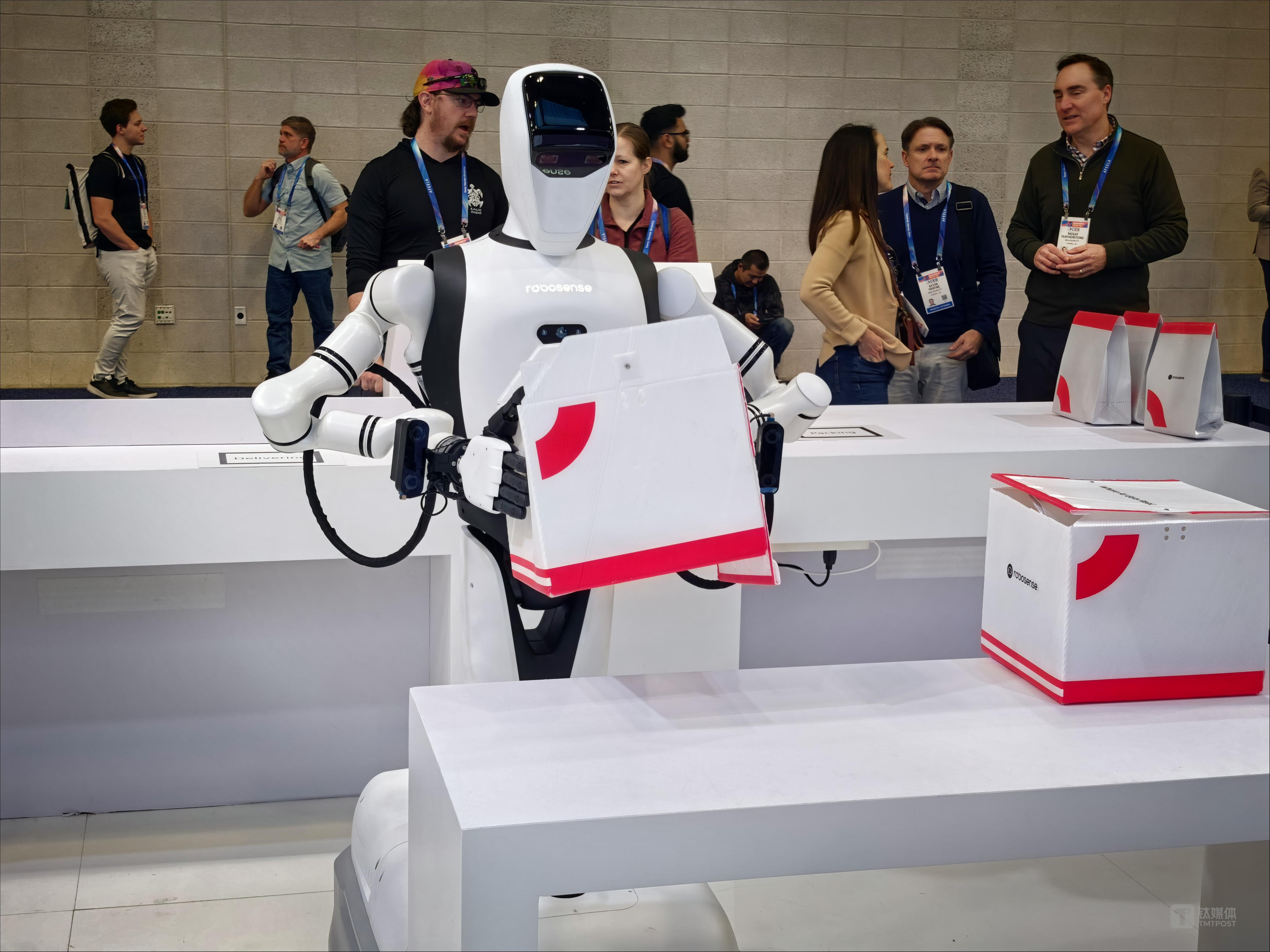
Embodied artificial intelligence moved from research labs toward commercial reality at CES 2026 over the past week, as Chinese robotics and sensor companies showcased machines capable of performing complex physical tasks with minimal human intervention.
While humanoid robots drew crowds on the exhibition floor, it was the underlying technologies — particularly vision, manipulation and task-planning systems — that signaled the industry’s shift from demonstration to deployment.
Among the most closely watched exhibitors was RoboSense, a Chinese lidar and robotics technology supplier, which presented an autonomous “delivery robot” capable of completing an entire logistics workflow without remote control — from packing parcels and transporting them to unpacking and recycling boxes.
RoboSense Chief Executive Qiu Chunchao said the demonstration marked the company’s first global unveiling of a complete embodied intelligence system.
“This is probably the longest continuous live operation of this kind without remote control,” Qiu told Reuters. “For us, embodied intelligence is no longer a concept — it is now a closed-loop, end-to-end technology system.”
Autonomous delivery vehicles have made progress in transporting goods across cities and campuses, but the final stage — navigating buildings, handling parcels and interacting with physical environments — still relies heavily on human labor.
That gap, often referred to as the “last 100 meters” challenge, is becoming more acute as labor shortages grow and demand for instant delivery rises, particularly in dense urban and high-end residential areas where bikes or scooters are restricted.
At CES, RoboSense demonstrated a simulated end-to-end logistics process, covering what it described as both the “first 100 meters” and the “last 100 meters” of delivery.
“Picking up a box, opening it, packing items, closing it, transporting it, unpacking it and folding the box — these look simple to humans,” Qiu said. “But behind each of these actions are more than 20 subtasks, and many of the objects involved are soft and deformable, which makes the problem much harder.”
The technical bottleneck, he said, lies not in mobility — where self-driving technologies are relatively mature — but in upper-body capabilities, especially dexterous hands and operational vision.
“Legs can tolerate errors of several centimeters,” Qiu said. “Hands cannot. You need millimeter-level precision.”
To address that challenge, RoboSense introduced what it calls an “Active Camera” system that fuses solid-state time-of-flight lidar, binocular RGB cameras and inertial sensors into a single hardware unit for three-dimensional perception and motion tracking.
The system maintains distance accuracy within plus or minus 5 millimeters at up to 8 meters, according to the company, allowing robots to locate and manipulate objects in complex lighting and cluttered environments.
The robot’s hands are equipped with arrays of force and tactile sensors, which provide feedback when vision alone is insufficient — such as when grasping soft packaging or objects partially hidden from view.
These inputs are processed by RoboSense’s self-developed VTLA-3D manipulation model, which integrates visual, spatial and tactile data to guide precise movement.
The robot also uses a separate task-planning AI that breaks down abstract goals — such as “deliver this package” — into executable atomic steps, creating what Qiu described as a “dual-speed system” combining long-term planning with real-time control.
RoboSense, best known for its lidar sensors used in autonomous vehicles, is using embodied intelligence to reposition itself higher up the value chain.
Over the past decade, the company has reduced lidar costs from tens of thousands of dollars per unit to roughly $100, helping accelerate adoption across industries.
“Our positioning is still as a supply-chain company,” Qiu said. “But in the future, we want to create more value through robots — not just through sensors, but through systems.”
The company plans to expand its portfolio of robot components, including vision modules, dexterous hands and joints, with a near-term focus on perception and manipulation.
According to its latest quarterly report, RoboSense shipped 35,500 units in robotics and related sectors, up 393% year-on-year. Overseas revenue more than doubled, the company said.
China’s growing presence
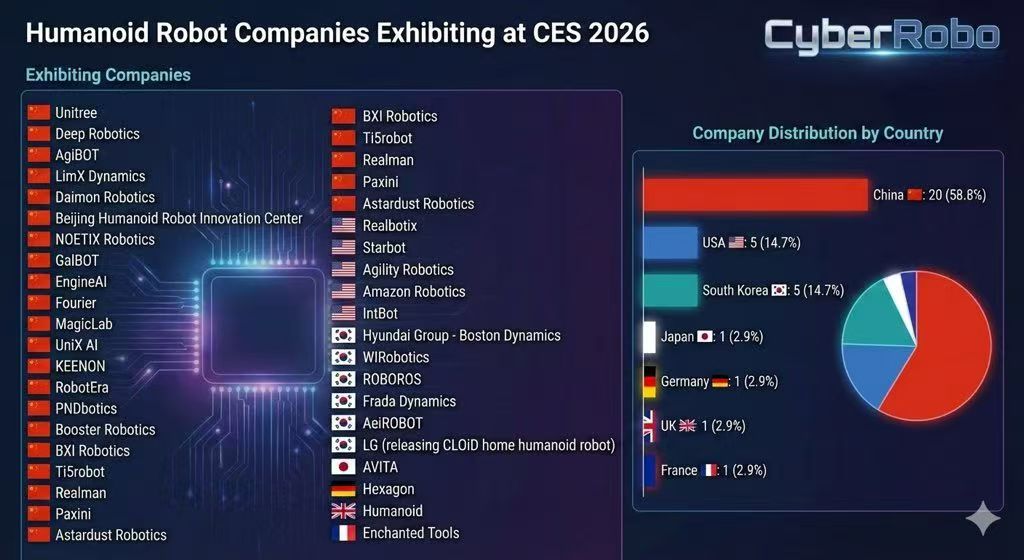
RoboSense was one of dozens of Chinese firms showcasing embodied AI technologies at CES, underscoring China’s growing role in the global robotics supply chain.

Analysts say Chinese companies benefit from close integration of hardware manufacturing, software development and cost optimization — enabling faster iteration and commercialization than many Western rivals.
“China has a structural advantage in embodied intelligence because it combines AI talent with large-scale hardware production and real-world deployment environments,” said one robotics industry analyst who asked not to be named.
As embodied AI moves from spectacle to service, the focus is shifting from humanoid form factors to reliability, scalability and cost.
“The real question is not whether robots can do these tasks,” the analyst said. “It’s whether they can do them reliably, cheaply and at scale.”
For RoboSense, Qiu said the answer lies in turning robotics into infrastructure — much like personal computers or smartphones.
“Our long-term goal is to make robots simple, reliable and practical,” he said. “When that happens, embodied intelligence will stop being a showcase — and start being part of everyday life.”
更多精彩内容,关注钛媒体微信号 (ID:taimeiti),或者下载钛媒体 App