



Chinese quantum computing company QBoson announced the completion of a multi-hundred-million-dollar Series A++ funding round, marking a major milestone in its efforts to industrialize photonic quantum computing and accelerate the convergence of quantum computing and artificial intelligence.
The funding round was co-led by Huade Tech Innovation and Nanshan Strategic Emerging Investment, with participation from major institutions and publicly listed companies including GF Xinde, Hunan Caixin Industrial Fund, and Weide Information. Existing shareholder QF Capital also increased its stake, reflecting strong investor confidence in QBoson’s technology roadmap and commercialization potential.
According to the company, the newly raised capital will be used to support research and development of dedicated and general-purpose coherent photonic quantum computers, advance quantum chip fabrication capabilities, construct and operate China’s first large-scale dedicated photonic quantum computer manufacturing plant in Nanshan District, Shenzhen, and expand the commercial ecosystem for integrated “Quantum Computing + AI” applications.
This marks QBoson’s sixth publicly disclosed funding round since its founding in late 2020, demonstrating sustained investor enthusiasm in the growing quantum computing sector in China.
Co-founders Wen Kai and Ma Yin emphasized that following this round, the company will deepen its technological roadmap and ecosystem development in the “Quantum Computing + AI” field. By leveraging quantum Boltzmann machines, QBoson aims not only to accelerate the shift toward more precise and efficient research and development paradigms in life sciences and drug discovery but also to advance practical applications of quantum computing across multiple industries.
Founded in Beijing’s Chaoyang District, QBoson is the city’s only hard-tech enterprise specializing in photonic quantum computing devices. The company primarily focuses on dedicated photonic quantum computer solutions and has launched a comprehensive range of products and services, including coherent photonic quantum computers with 100 and 550 computational qubits, the Wuyue Photonic Quantum Computing Cloud Platform, the Kaiwu SDK quantum computing development kit, the Liangshu all-in-one photonic quantum measurement and control system, and the Lianggui fiber-optic temperature control device for dedicated photonic systems.
QBoson has also established China’s first practical quantum computing developer community, enabling enterprises to explore and apply quantum computing in commercial scenarios.
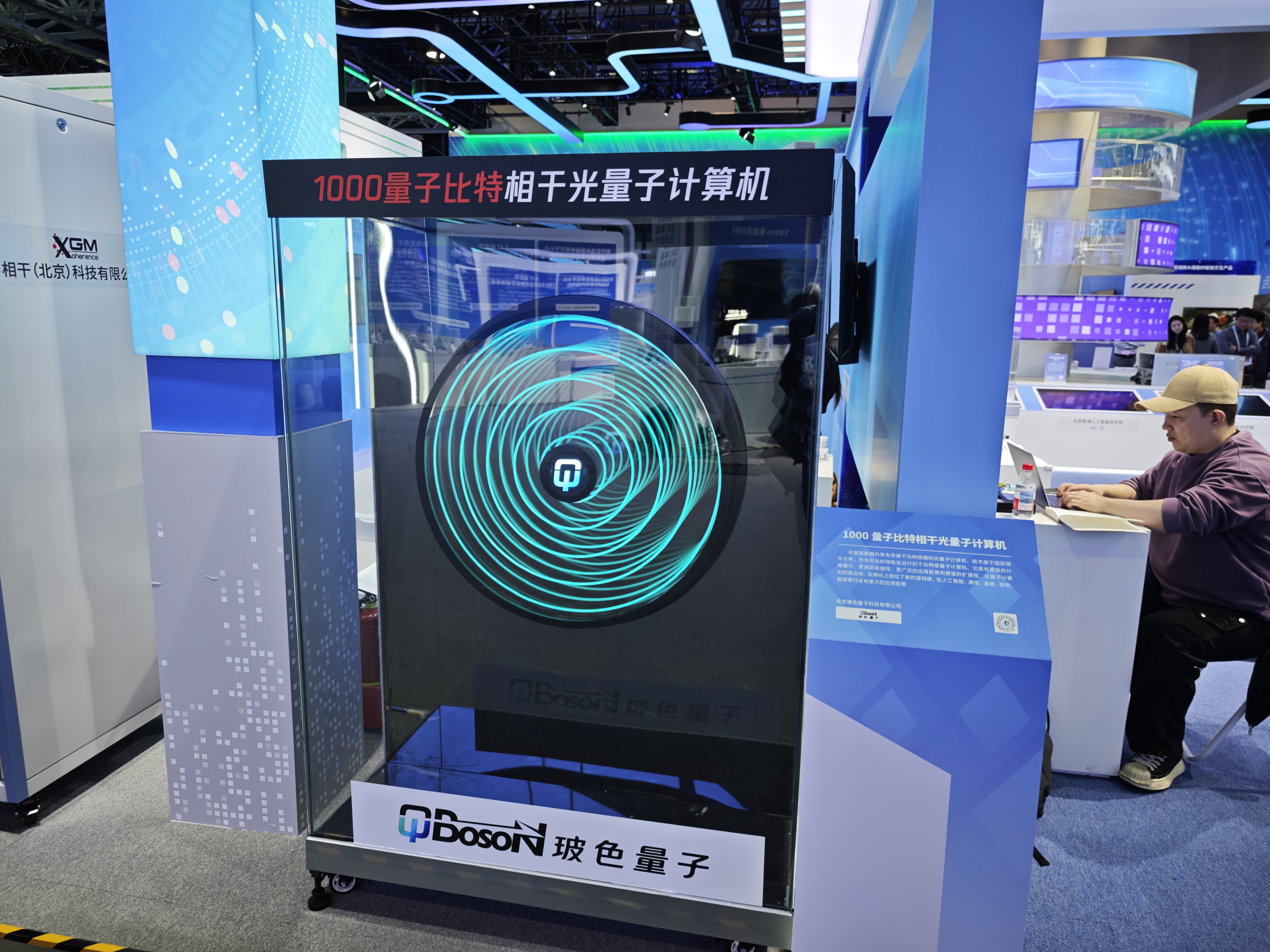
On the hardware front, QBoson recently unveiled a domestically developed, fully controllable 1,000-qubit dedicated coherent photonic quantum computer. The system provides a full suite of development tools and verification platforms, covering the entire process from problem mapping and resource scheduling to quantum state evolution.
By leveraging the PyTorch ecosystem, the company has open-sourced several quantum-native AI training toolkits, reducing barriers to quantum computing applications and expanding the developer ecosystem. These advancements allow research institutions and industries to harness the advantages of quantum computing, accelerating the transformation of scientific discoveries into industrial applications.
On the software side, QBoson’s 100-qubit quantum cloud platform has seen significant adoption since its launch, with over 68 million problem-solving requests and coverage of more than 900 universities, involving over 10,000 developers in research and development. These efforts have demonstrated the potential of quantum cloud services to support government, academic, and enterprise users in complex computational tasks.
QBoson has completed six rounds of funding, with investors including Beijing China Mobile Digital New Economy Industry Fund, Huakong Fund, Dianliang Capital, Yuanhe Capital, and Chaokechuang. Its previous Series A round, completed in October 2024, was also a multi-hundred-million-yuan investment led by Qifu Capital, with participation from Ameba Capital, Yuanhe Capital, and Yingfu Taike.
In terms of commercialization, QBoson provides solutions for applications in AI, finance, cloud computing, education, and AI for Science (AI4S). Its Boltzmann Machine-Variational Autoencoder (QBM-VAE) models have been applied to peptide generation, small molecule creation, single-cell clustering, mRNA vaccine optimization, and multi-omics protein analysis, helping to shorten drug development cycles, improve genomics research accuracy, and reduce costs.
QBoson has also partnered with leading institutions such as the Guangzhou National Laboratory, Shanghai Jiao Tong University, Sun Yat-sen University School of Pharmacy, Beijing Cancer Hospital, and Tsinghua Chang Gung Hospital to explore practical quantum computing applications in protein structure prediction, molecular similarity screening, peptide docking, and allosteric site prediction.
The company has established a pharmaceutical company–university–hospital–national laboratory collaborative system and plans to deepen cooperation with top universities and pharmaceutical companies to accelerate drug development and clinical validation using quantum computing.
Globally, quantum computing continues to attract strong attention. The 2025 Nobel Prize in Physics, awarded to John Clarke, Michel H. Devoret, and John M. Martinis for discoveries in macroscopic quantum phenomena, has reignited public interest in quantum technologies. Current quantum computing approaches include low-temperature superconducting, ion trap, neutral atom, photonic quantum, and silicon-based systems, with superconducting and ion trap technologies considered the most promising for universal quantum computers.
Experts agree that to build a practical quantum computer, three key performance metrics must be met: a theoretical qubit count of 200, quantum gate fidelity of 99.9%, and coherence times of tens of microseconds. Meeting these criteria would allow quantum computers to perform tasks such as drug molecule screening and chemical simulations faster than classical systems.
According to the China Academy of Information and Communications Technology (CAICT), as of August 2025, there are more than 400 quantum computing companies worldwide, with China and the United States leading the global landscape. In the first half of 2025, the sector secured over $2 billion in financing, with multiple deals exceeding $100 million each, and total annual investment expected to reach new heights.
Industry analysts project that global quantum computing revenue will surpass $1 billion in 2025, with the overall quantum technology market potentially reaching $97 billion by 2035, of which quantum computing alone could account for $28 billion to $72 billion. By 2040, the market is expected to exceed $190 billion, with fault-tolerant, universal quantum computers containing millions of qubits achievable by 2035.
With its latest funding and technological advancements, QBoson is positioning itself at the forefront of this rapidly evolving industry, aiming to drive practical applications of photonic quantum computing and integrate quantum power into AI-driven industrial and scientific breakthroughs.
更多精彩内容,关注钛媒体微信号 (ID:taimeiti),或者下载钛媒体 App