


NextFin News -- In the summer of 2026, a series of control experiments quietly upended the foundational assumptions of the smart robotics sector. An elite research alliance led by Stanford Professor Fei-Fei Li, Nvidia’s Embodied AI lead Jim Fan, and Georgia Institute of Technology Assistant Professor Danfei Xu—alongside top-tier automation scholars Pieter Abbeel, Jitendra Malik, Ken Goldberg, and Trevor Darrell—encountered a striking setback when testing a classic industry AI model known as $\pi_{0.5}$.

The researchers had attempted what seemed like a logical optimization: feeding continuous digital touch data into the system alongside its existing visual inputs. The underlying thesis was standard for modern software engineering—that giving a machine more data should naturally yield greater operational precision. Instead, empirical testing revealed that task success rates plummeted from 17% down to just 6%. Far from achieving a breakthrough, the addition of haptic feedback rendered the robots significantly less capable of executing physical workloads.
This counterintuitive outcome offers a timely reality check to the broader tech sector. For years, the prevailing paradigm has been to funnel every available sensory stream—vision, language, and touch—into a single, massive neural network. The widespread assumption was that if programmers supplied enough raw data, higher machine intelligence would simply emerge. The team's research paper, introducing a decentralized processing framework named T-Rex, proves with hard data that this single-pipeline approach is structurally flawed.
A Conflict of Chronologies
The root cause of this operational failure lies in a severe timing mismatch between different machine senses. Vision is a slow, macro-level variable. Standard digital cameras scan an environment at roughly 5 frames per second, providing stable context about where objects are and what they look like.
Touch, however, is a high-frequency, dynamic variable. The exact millisecond a robotic finger makes contact with a surface, variables such as friction, pressure, and material deformation shift instantaneously. To be useful for fine manipulation, haptic feedback must process data at a frequency of 20 Hz or higher.
Forcing these vastly different temporal scales into a single AI model creates severe data pollution. The high-speed resolution of touch is effectively muted by the slower processing speed of the camera, while the rapid influx of tactile feedback disrupts the stable visual representations the machine has already learned. Instead of creating multi-modal harmony, the combined senses cross-contaminate, degrading overall mechanical performance.
Recognizing this core structural conflict, the research team bypassed minor software patches and chose to rewrite the control architecture entirely. They developed T-Rex, short for Tactile-Reactive Dexterous Manipulation. The central thesis behind T-Rex is straightforward: stop forcing vision and touch to compete for the same central processing channel, and provide tactile data with its own independent highway.
A Division of Labor
To implement this segregated processing model, the paper introduces a specialized framework called the Mixture-of-Transformers (MoT) architecture. This setup divides control among three distinct digital "experts," allowing each to operate at its native clock speed without causing system lag or channel interference.
The first component, the Latent Expert, acts as a long-range planner. It monitors visual and language feeds to predict how a scene will change, setting the broader temporal context for the robot's upcoming movements.
The second component, the Action Expert, handles macro-level path planning. Starting with a rough outline, this module maps out the general trajectory of a robotic limb—such as moving toward a specific object. This process runs at a standard frequency of approximately 5 Hz, matching the natural rhythm of visual tracking sensors.
The third component, the Tactile Expert, manages split-second micro-adjustments. This module completely ignores global path planning and remains idle until the exact millisecond physical contact occurs. Once activated, it reads fingertip pressure and shape data at an ultra-high speed of 20+ Hz. It then applies millisecond-level corrections directly onto the rough path drawn by the Action Expert, instructing the hand to grip lighter or shift a millimeter to the left.
During operation, the Action Expert guides the limb toward the target, and the Tactile Expert takes over mid-movement to refine the final grip using fresh touch data. This gives high-speed touch signals an independent channel, preventing them from being dragged down by the slower rhythm of vision-based inputs.
To help the Tactile Expert truly understand touch signals, the team built a custom data translator built on a VQ-VAE module. This component compresses rapid streams of raw pressure data into discrete "touch words." This process captures changing force trends while insulating the system against sensor glitching and signal drift, handing the AI a clean, standardized language instead of messy raw data.
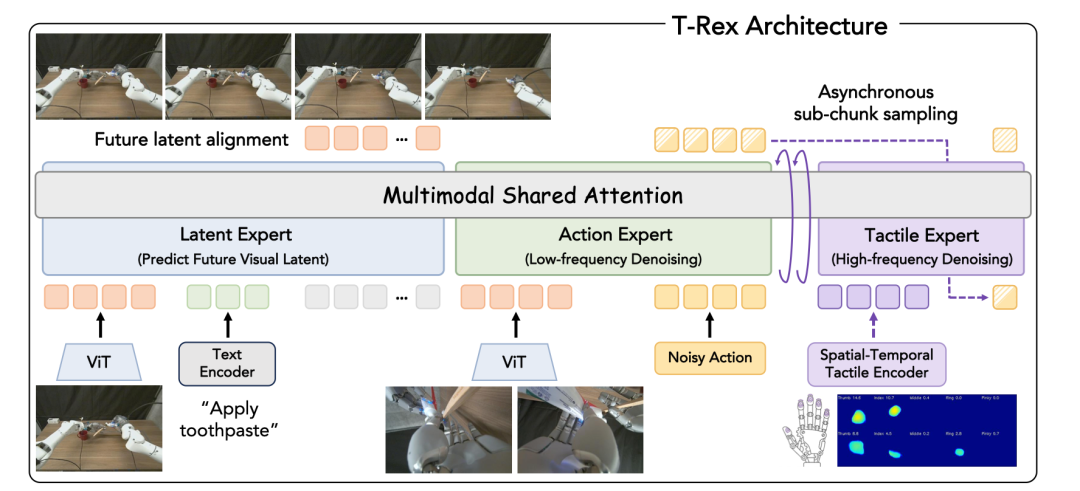
T-Rex’s Mixture-of-Transformer-Experts (MoT) architecture. (Image source: T-Rex)
The team also put immense effort into data collection, building a synchronized haptic dataset comprising 100 hours of continuous testing. This database covers over 200 consumer items and 22 basic movements, like grasping, squeezing, inserting, and wiping across more than 7,700 unique trajectories. Rather than training the robot on isolated tasks, they paired every action against every object. This cross-combination forces the model to learn a generalized understanding of physical touch rather than memorizing rigid, repetitive routines.
The training itself uses a multi-step approach. The AI is first pre-trained on nearly 23,000 hours of human video to understand hand movements. It is then aligned with the 100-hour robotic touch dataset, and finally fine-tuned with a few small demonstrations of specific tasks. This ensures the robot doesn't have to learn how to touch from scratch; instead, touch is grafted onto an already established visual foundation using minimal data.
From Clumsy to Capable
The performance of the T-Rex framework was validated across 12 high-precision tasks explicitly designed to test mechanical compliance limitations. These included turning delicate book pages, transferring raw eggs, wiping dishes, squeezing toothpaste tubes, separating stacked paper cups, sorting mahjong tiles, unlocking doors, and threading lightbulbs. Every scenario requires continuous, real-time adjustments to physical pressure.
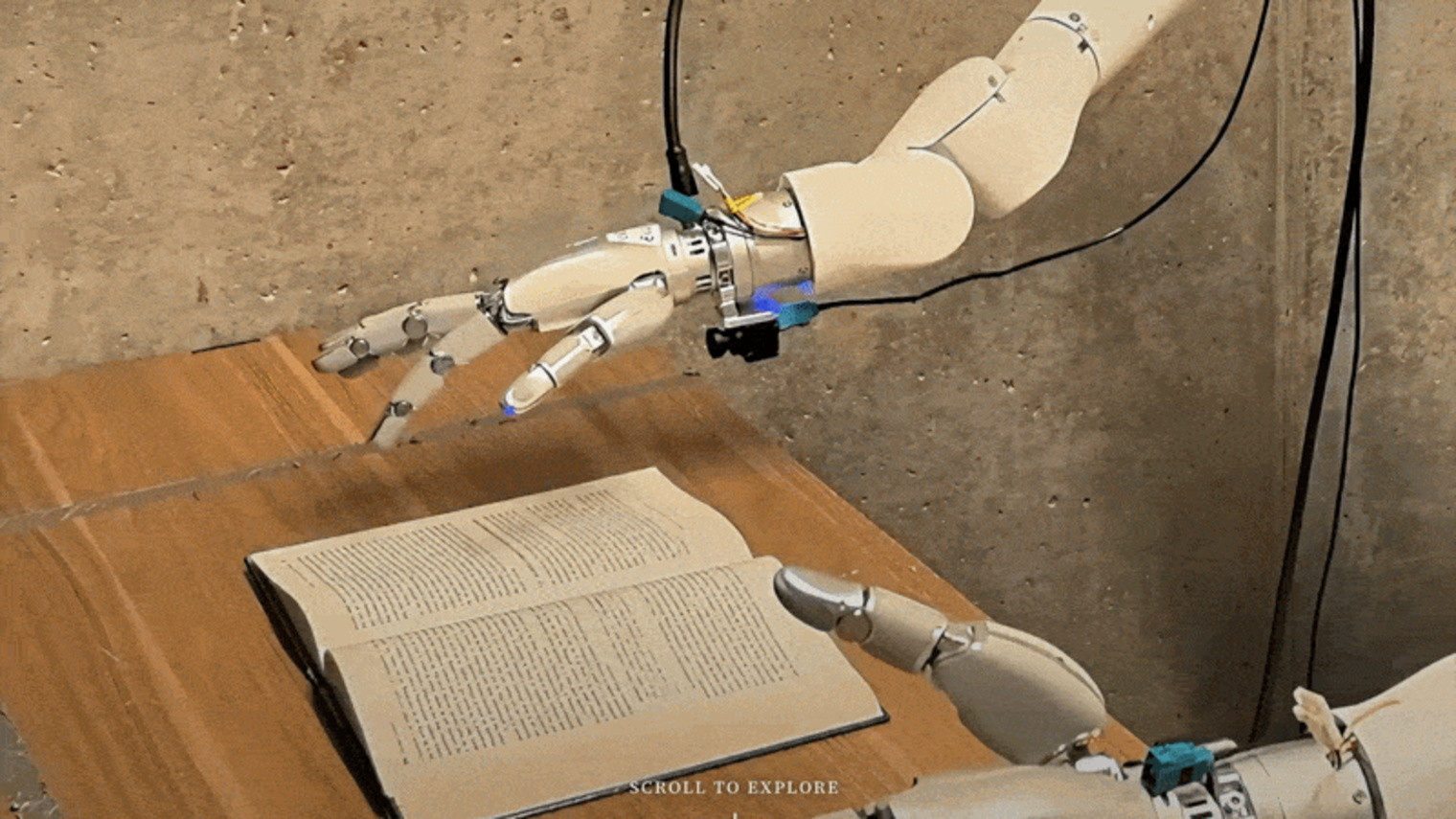
T-Rex performing contact-intensive tasks such as flipping through a book (Image source: T-Rex)
The empirical results showed that T-Rex delivered an average success rate improvement of over 30% across all 12 tasks compared to leading baseline models. In highly force-sensitive tasks, like turning individual pages or separating thin paper cups, the system's capabilities advanced from completely unusable lab prototypes to genuine practical readiness.

"Ablation protocols confirmed that entirely removing haptic input channels triggered an immediate collapse in system success rates. Similarly, forcing the architecture into a synchronous operational mode—where tactile data streams were artificially downsampled to match visual frequencies—caused significant performance degradation," the researchers noted.
These outcomes demonstrate that T-Rex succeeds because it grants high-frequency touch its own independent tempo and processing logic.
The broader significance of the T-Rex study extends far beyond laboratory numbers. It serves as a clear warning to the wider robotics industry: the common paradigm of treating all inputs the same way and dumping them into one large AI model does not work for physical interaction.
While slow variables like vision and language are well-suited for big-picture reasoning inside a massive AI model, rapid variables like touch require their own high-speed, closed control loops. Forcing both into the same mold causes data pollution, not integration.
This separation of pathways mirrors the classic dual-stream hypothesis in neuroscience, where one visual pathway identifies what an object is, and a separate pathway guides how our hands interact with it. The mixture-of-experts approach used in T-Rex effectively replicates this biological wisdom within robotic hardware.
The paper acknowledges that engineering challenges remain. Complex multi-step maneuvers still require a massive amount of demonstration data, and current touch sensors are confined to the fingertips rather than spanning the entire palm. However, the T-Rex framework marks a clear turning point. The research suggests that future robotic systems cannot rely on visual inputs alone; it is time to stop making robots just stare at the world and finally teach them how to feel it.
(First published on the TMTPost App; author | Silicon Valley Tech-news; editor | Zhao Hongyu)
更多精彩内容,关注钛媒体微信号 (ID:taimeiti),或者下载钛媒体 App