
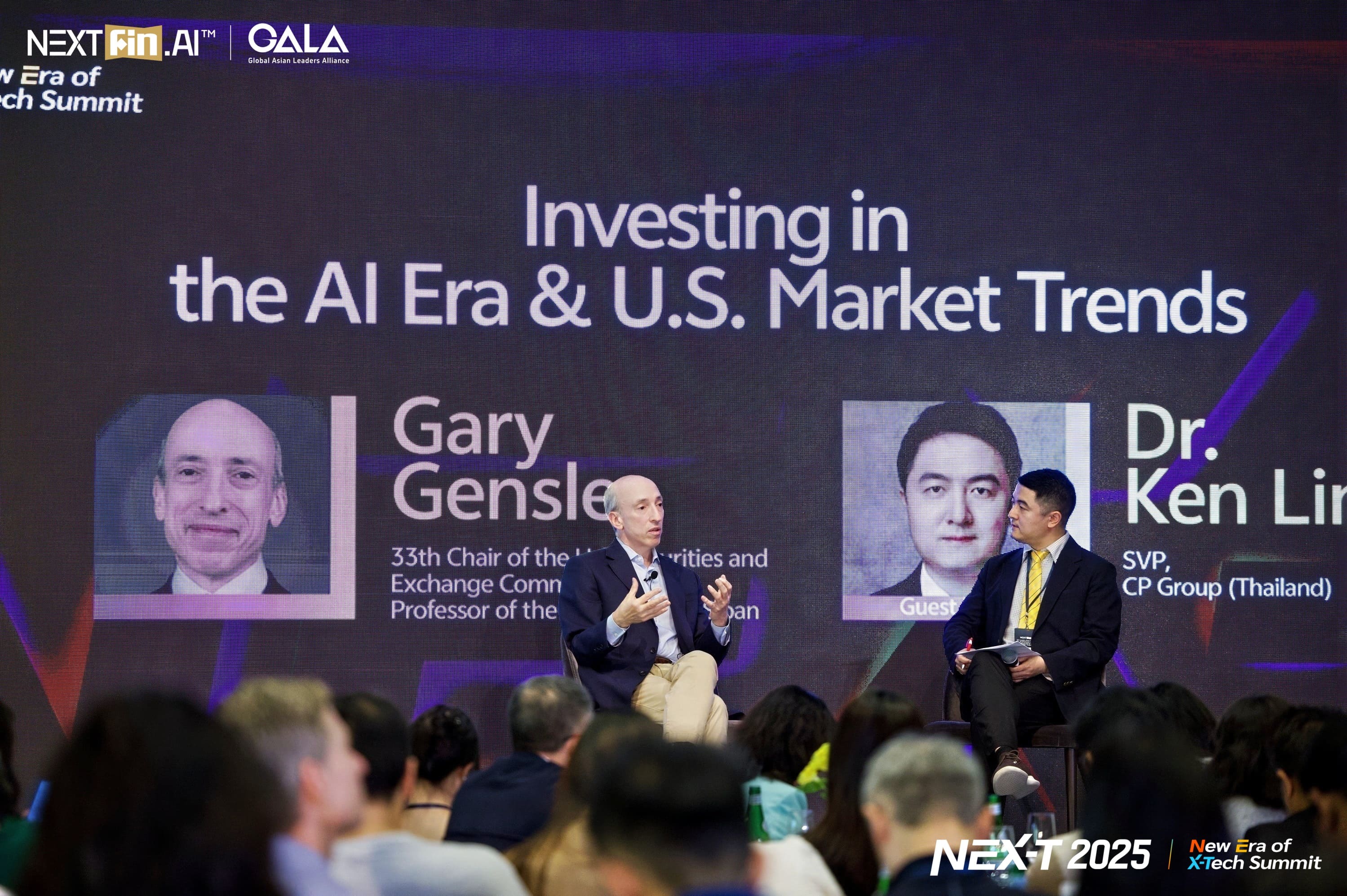


On-site photo

Gary Gensler, former chair of the U.S. Securities and Exchange Commission (SEC), warned that companies ignoring artificial intelligence (AI) risk would be left behind, comparing them to a "slow deer" in a race. Yet, he pointed out a paradox — as AI becomes ubiquitous across the industry, maintaining a true competitive edge, or "alpha," grows ever more elusive.
He made the remarks on September 27 at the NEX-T Summit 2025 hosted by NextFin.AI and Global Asian Leadership Alliance (GALA) in Silicon Valley.
In the dialogue titled "Investing in the AI Era & U.S. Market Trends," he stressed that AI has been evolving for decades, but only now is its scale, speed, and commercial application reaching a tipping point.
In finance, AI is no longer optional: asset managers and investors need it simply to keep pace with the market. "If you don't use AI at all, maybe you're the slow deer — you'll get left behind," he warned. Yet, he noted the paradox: as AI adoption becomes widespread, competitive advantage — or "alpha" — becomes harder to sustain.
For smaller financial firms, Gensler sees opportunities in becoming technical service providers, helping mid-tier institutions with AI model building, data orchestration, and RAG (retrieval-augmented generation) workflows. "Even small hedge funds need this," he said, pointing to a growing market for nimble firms in the AI ecosystem. Startups focused on credit analysis for small and medium-sized enterprises (SMEs) also present fertile ground, though access to quality, proprietary data remains a critical bottleneck.
"I truly believe AI has been and will continue to be a transformative technology," Gensler argued. "It's not new — it didn't just start with generative AI or OpenAI. It's been evolving for decades." But what's new, he said, is the scale, speed, and commercial reach of AI across industries — particularly in finance, where automation and data-driven decision-making are rapidly becoming indispensable tools.
Gensler, also the Professor of Practice at the MIT Sloan School of Management, emphasized that while many people associate AI with flashy consumer applications — like chatbots or virtual assistants — the real potential lies deeper, in what he called "the meat of finance."
"Think about investing and trading," he said. "If you're in asset management, your key job is to beat the market to generate alpha. But here's the tricky part: what happens when everyone starts using AI?"
He described a growing paradox in modern finance. On one hand, AI has become a baseline requirement — "the toolkit you need just to stay even," as he put it. On the other, widespread adoption makes it harder for any one firm to maintain an edge.
For smaller financial players — those without the balance sheets of J.P. Morgan, BlackRock, or the Bank of America — Gensler sees massive opportunity in service provision. "There's a lot of value in being the shop that builds or maintains the RAG models, cleans up data, or orchestrates AI pipelines," he said. "If you're not a trillion-dollar institution, you're probably relying on outside vendors anyway. So, service providers have an incredible business opportunity in this ecosystem."
When asked about U.S. market trends, Gensler struck a cautious tone. "This is not investment advice," he prefaced with a wry smile. "But we have a stock market right now that's riding on a lot of AI momentum."
He pointed to valuation metrics that suggest potential overheating: the U.S. market trades at a trailing price-to-earnings ratio of about 31 and represents 225% of GDP — roughly $67 trillion in market value against $30 trillion in economic output. "They're great companies," he said, "but the question is: are they priced for perfection?"
To Gensler, the sectors most ripe for investment are those not yet fully recognized as AI beneficiaries. "You don't want to chase the ones everyone's already talking about," he said. "Look for the industries that will be quietly transformed by AI — the ones that haven't priced that in yet."
In one of the session's lighter moments, a Thai agribusiness leader asked how traditional industries — such as poultry farming — could benefit from AI. Gensler responded earnestly: "You're still dealing with customers, logistics, and inventory cycles. Whether you're selling chickens or chips, AI can help manage demand prediction, supply chain efficiency, even weather forecasting."
He added that companies should always "look over their shoulder" for disruptive entrants. "You don't want to be the one getting disrupted. Sometimes you have to let internal entrepreneurs challenge your orthodoxy — even if it feels uncomfortable."
Asked whether giants like Amazon, Google, Microsoft, and Meta were forming an AI monopoly, Gensler said their dominance stems largely from cash-rich balance sheets rather than anti-competitive intent. "They can afford to spend $300 billion on AI infrastructure," he said. "And unlike previous bubbles — like the railroad boom in the 19th century or the 2008 housing crisis — this one isn't fueled by debt. That's an important distinction."
However, he cautioned that investors should still "look under the hood," especially in the data center world. "There's real innovation happening, but also real financial risk. Debt can still creep in through smaller infrastructure players."
For startups, Gensler sees two broad paths to success. First, as technical service providers for mid-tier financial institutions, offering APIs, orchestration layers, and retrieval-augmented generation (RAG) solutions. "Even small hedge funds need this," he noted. "There's room for nimble firms to thrive here."
Second, he pointed to fintech innovation in credit markets — especially lending to SMEs. "Alibaba started doing this six or seven years ago — using AI to assess creditworthiness among millions of merchants," he recalled. "Someone will build a private credit platform for SMEs outside of China, using new data sources legally and creatively. That's a real opportunity."
Still, he warned that access to quality data remains a critical bottleneck. "If you don't have Alibaba's data, you need to find ethical, proprietary ways to get your own."
On the regulatory front, Gensler acknowledged that AI presents new challenges — particularly around misinformation, fraud, and deepfakes. "It's not a new problem," he said, "but the threat actors have new tools now."
Recalling his time at the SEC, Gensler described an incident when a deepfake video falsely reported an explosion at the Pentagon, briefly moving markets. "That's a real problem," he said. "It shows how quickly false information can propagate and impact financial systems."
He compared the current public anxiety over AI-generated misinformation to the 1938 War of the Worlds radio broadcast that caused panic over a fictional alien invasion. "Technology keeps changing," he said, "but human psychology doesn't."
Turning to geopolitics, Gensler said the AI race between the U.S. and China is fundamentally a race across three dimensions — math, data, and compute.
"China has a data advantage," he explained. "They have 1.4 billion people and a centralized system that can consolidate data. The U.S., on the other hand, has advantages in compute — thanks to companies like NVIDIA — and in academic innovation."
He predicted that while the U.S. currently leads, the balance could shift. "Ten years from now, it could easily be the other way around. The question is how other regions — Latin America, Africa, Europe — build resilience if they depend on U.S. or Chinese AI cloud infrastructure."
Although the session focused on AI, Gensler was inevitably asked about cryptocurrency. He smiled: "I have zero Bitcoin."

He contrasted AI's tangible value proposition — in predictive analytics and natural language processing — with crypto's more speculative nature. "Every asset, since the time of Hammurabi, has been valued on fundamentals and sentiment," he said. "But rarely do assets survive when 99% of their value is based on sentiment."
Stablecoins, he acknowledged, serve a functional role as digital dollars, but the thousands of other tokens lack clear fundamentals. "At some point, fundamentals catch up with sentiment. That's finance 101."
As the dialogue drew to a close, Gensler reflected on the broader economic implications of AI. "Capitalism always survives — but it changes," he said. "If labor gets crushed and capital gets concentrated, capitalism still works in theory. But at some point, inequality fuels revolt."
The key, he suggested, is maintaining diversity of thought and participation in markets. "You need differences of opinion to drive trading and price discovery. If everything becomes too centralized, markets get brittle — and volatility rises."
In the end, Gensler's message was both cautionary and optimistic: AI will reshape every corner of the economy, from Wall Street to chicken farms. But in doing so, it demands wisdom — and humility — from its creators and users alike. "Technology," he said, "is only as good as the hands that wield it."
更多精彩内容,关注钛媒体微信号 (ID:taimeiti),或者下载钛媒体 App