

On-site photo

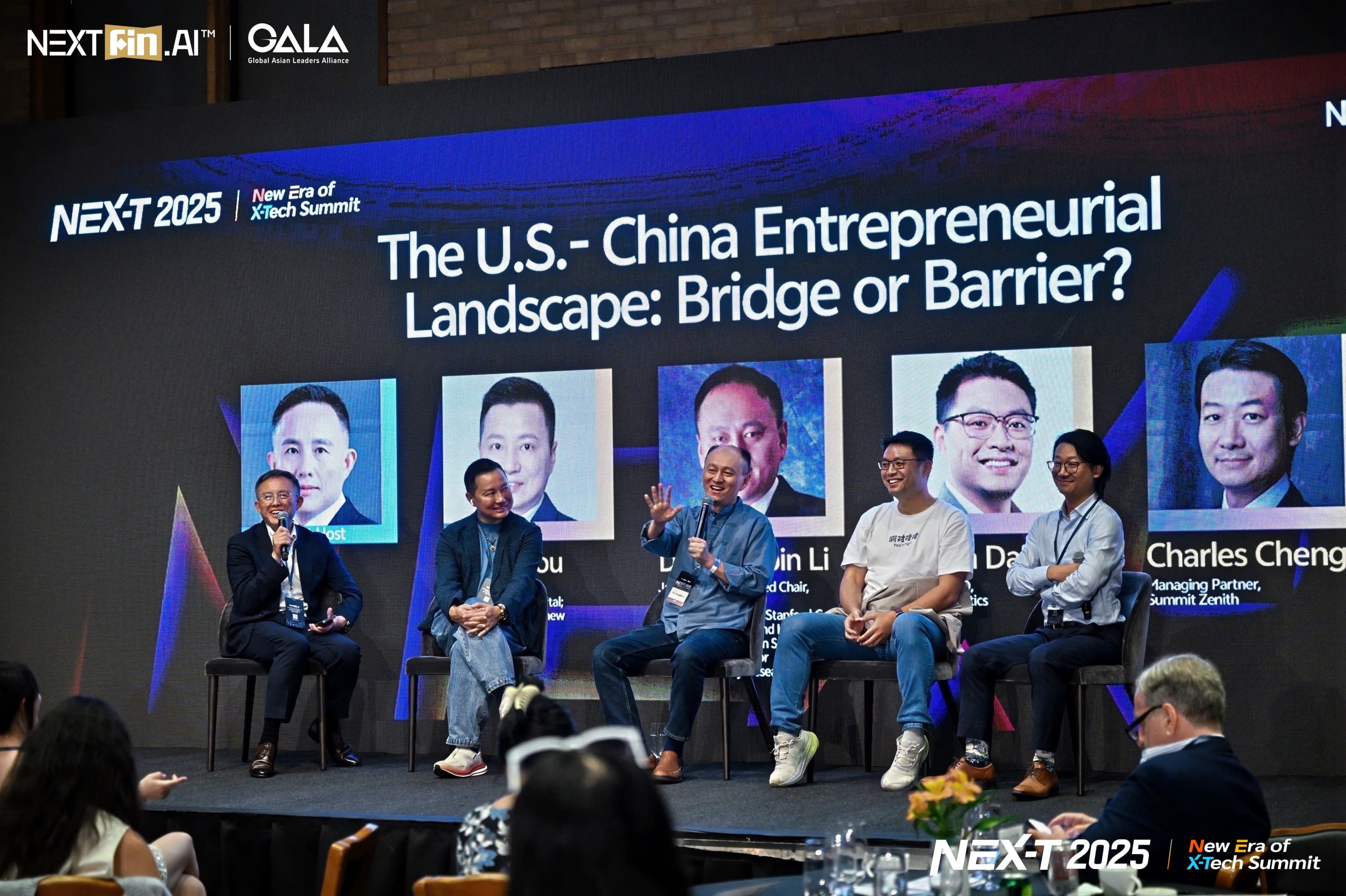
TMTPOST -- Globalization has become an unavoidable question, and perhaps the ultimate test, for every ambitious Chinese entrepreneur seeking to build a company with lasting global impact, said Hang Zhou, the partner of Shunwei Capital, at the NEX-T Summit 2025 hosted by NextFin.AI and Global Asian Leadership Alliance (GALA) in Silicon Valley.
At the panel "The U.S.-China Entrepreneurial Landscape: Bridge or Barrier?" on September 27, he joined discussions with Hongbin Li, James Liang Endowed Chair of Stanford University; Tristan Dai, the founder and CEO of Notiom Robotics; and Charles Cheng, the managing partner of Summit Zenith LLP.
For Zhou, an angel investor who has built companies in both China and the United States, the contrast between the two ecosystems is striking. He observed that while U.S. entrepreneurship appears more relaxed and open, China's environment is far more competitive. "In the U.S., startups enjoy a more forgiving atmosphere as projects that might never secure funding in China can raise capital here," Zhou noted. "But at the same time, the threshold for talent in China is much higher. An entrepreneur with a doctoral degree in China might face competition equivalent to a college student's level of intensity here."
Despite these differences, Zhou emphasized that entrepreneurship remains an inherently rewarding pursuit. "The sense of accomplishment and growth from building something of your own is irreplaceable," he said. "Today's young Chinese entrepreneurs are born global. Globalization isn't optional anymore, it's the question every ambitious founder must answer."
Dai, who has operated businesses across China and the U.S. for more than a decade, offered a ground-level view of rising tensions. His company, Notiom Robotics, spans industries from virtual production to humanoid robotics — fields now deeply intertwined with geopolitics and AI regulation.
"In the past, it felt much easier to run cross-border business," Dai recalled. "You just had to prove your innovation. Now, you have to innovate under constraints — new compliance rules, data restrictions, and political boundaries."
He added that while innovation remains his north star, the operational landscape has grown more complicated. "When I work in China, I serve all the major AI and robotics companies. But when I bring my services to the U.S., it's very hard," Dai said. "Small contracts are fine, but once a project hits the $1 million mark, you're buried in compliance checks and due diligence. It takes enormous extra effort and cost."
Despite these challenges, Dai maintains his global vision. "We can't give up on international collaboration," he said. "We just have to work harder to make it feasible."
For Cheng, the investor and legal advisor who works with clients on both sides of the Pacific, the current picture is one of paradoxical vitality. "There's a mixed feeling among my clients," he said. "Local startups in the U.S. are booming thanks to the AI wave — investors, engineers, researchers, everyone is excited. But for Asian entrepreneurs expanding into the U.S., the story is more nuanced."
According to Cheng, Chinese and Asian companies — from e-commerce to entertainment — continue to view the U.S. as the most profitable market, despite tariffs and trade barriers. "You can see this even in lifestyle sectors," he noted. "Brands like Luckin Coffee are opening stores in the U.S. Southeast Asian dramas produced by Chinese studios are targeting American audiences and attracting venture funding. Yet industries under heavy political scrutiny, like semiconductors or data platforms, are cooling down."
Cheng believes that rather than full decoupling, businesses are adapting to a three-world strategy: focusing separately on the U.S., China, and a neutral third region. "Some entrepreneurs register in the U.S. and raise capital from local VCs," he explained. "Others return to China for RMB-based funding, often supported by state initiatives. A third group sets up in neutral zones like Singapore, the Cayman Islands, or even Dubai — seeking distance from geopolitical risk."
Li, also the Faculty Co-Director of Stanford Center on China’s Economy and Institutions (SCCEI), brought an economist's perspective to the discussion. While Washington think tanks often paint a grim picture of U.S.-China relations, Li believes the interdependence runs deeper than policymakers acknowledge.
"If you ask people in Washington, they're pessimistic," he said. "But both countries are still negotiating trade agreements. The question is whether they can decouple without hurting their own economies. The answer is no — so a complete divorce is unlikely."
Li, also a senior fellow at Freeman Spogli Institute (FSI) & Stanford Institute for Economic Policy Research (SIEPR), warned that excessive national security regulations could have unintended consequences. "It's difficult to define what counts as a 'security concern.' If we push it to the extreme — banning Chinese students or research collaborations — both countries will suffer," he said. "The smaller the global market becomes, the less investment and innovation we'll see. Slower technology progress hurts everyone."
Li's broader message was one of rational cooperation. "In 50 years, both nations will still be great powers. If they cannot work together, humanity as a whole will suffer," he concluded. "If we're rational, we must find a way to collaborate."
Zhou, also the founder of YidaoYongchew, also touched on Southeast Asia and the Middle East — regions he described as "within China's economic radiation field." Having traveled across Indonesia, Malaysia, Thailand, Singapore, and Vietnam, he noted how many local companies still look to China for inspiration and partnership.
"If you're an entrepreneur in Southeast Asia, your instinct is to learn from China," Zhou said. "The lifestyles, urban patterns, and development levels are closer to China than to the U.S." He cited the Thai delivery startup featured in Netflix's Mad Unicorn — a company that scaled using Chinese capital, teams, and know-how. "Most of Southeast Asia's top tech firms, from Gojek to J&T Express, have deep Chinese roots," he noted.
However, Zhou warned that hopes of fully relocating China's manufacturing ecosystem to Southeast Asia are unrealistic. "People think you can just move the supply chain out of China," he said. "But ASEAN has 11 countries — and at least five of them are economically unviable. The others have their own deep structural issues. Vietnam has promise but also political constraints. And when social tensions rise, anti-Chinese sentiment reappears. So moving everything out of China comes with huge costs."
He added that America's dream of "manufacturing reshoring" is equally impractical. "Who's going to make low-margin consumer goods in the U.S. at $35 an hour?" Zhou asked rhetorically. "It's a political promise, not an economic reality."
In his closing remarks, Li turned to a theme from his recent research — the role of China's education system in shaping entrepreneurship. Comparing it to America's, he described China's as a "centralized, hierarchical tournament" that prizes test performance over creativity.
Yet, contrary to popular belief, Li argued that this system hasn't destroyed entrepreneurial spirit. "Around 7% of Chinese college graduates start a company — a massive number given the size of the population," he said. "At elite schools like Zhejiang University, it's 16%. Even at Tsinghua, it's about 10%."In comparison, about 17% of the U.S. college graduates started a company, according to a survey from Intelligent.com.
Interestingly, his research found that students who score highest on China's national college entrance exam, the gaokao, are less likely to become entrepreneurs — but those who attend top universities are more likely to succeed once they do. "So it's not education itself that stifles entrepreneurship," Li concluded. "It may be the social hierarchy or labor market incentives that steer young talent toward government jobs instead of startups."
As the discussion wound down, a clear message emerged: despite the political headwinds, innovation and entrepreneurship remain the strongest connective tissue between China and the United States.
"Technology and business are still the bridge," said Cheng. "Even during the Cold War, trade continued. You can't fully close an economy built on innovation."
"Entrepreneurship is still beautiful," Zhou echoed. "If politics hadn't gotten in the way, many Chinese founders would have stayed in the comfort of their home market. But now, globalization isn't just an opportunity — it's a test we all must face."
And in that shared test — of resilience, creativity, and cooperation — the panelists seemed to agree that the future of U.S.-China entrepreneurship will depend less on policy decrees and more on the persistence of those who keep building across the divide.
更多精彩内容,关注钛媒体微信号 (ID:taimeiti),或者下载钛媒体 App